Find us on:

How to Develop a Growth Mindset: 10 Science-Backed Strategies for Personal Growth

Have you ever felt that there was something about yourself you wanted to change?
Perhaps you want to become more confident, develop a new skill, improve your relationships, perform better at work, or simply become a better version of yourself. Personal development begins with the desire to grow, but lasting growth requires more than good intentions. It requires believing that change is possible.
Many people give up on their goals not because they lack intelligence or potential, but because they believe their abilities are fixed. They see failure as proof that they are “not good enough,” avoid challenges for fear of making mistakes, and underestimate their capacity to learn and improve.
The good news is that psychological research tells a different story. Our abilities are not as fixed as we often think. With effective strategies, deliberate practice, feedback, and persistence, people can develop new skills, strengthen existing ones, and continue growing throughout life.
This way of thinking is known as a growth mindset. It is the belief that your abilities, intelligence, and talents can be developed through learning, effort, and experience. Rather than seeing challenges as threats, people with a growth mindset view them as opportunities to learn and improve.
In this article, you’ll discover what a growth mindset is, how it differs from a fixed mindset, why it plays such an important role in personal development, and practical, science-based strategies you can use to cultivate it in your everyday life.
What Is a Growth Mindset?
The concept of a growth mindset was introduced by psychologist Dr. Carol Dweck, a professor at Stanford University, after decades of research on achievement, learning, and human motivation. Her research explored a simple but powerful question: Why do some people continue to grow in the face of challenges while others give up?
She found that the answer often lies not in intelligence or talent, but in the beliefs people hold about their own abilities.
According to Dweck, individuals generally tend to adopt one of two ways of thinking about their abilities:
- A fixed mindset, which assumes that intelligence, talent, and abilities are largely innate and unchangeable.
- A growth mindset, which views abilities as qualities that can be developed through learning, effective strategies, effort, and feedback.
In other words, a person with a growth mindset does not believe they are born either “good” or “bad” at something. Instead, they understand that improvement is the result of continuous learning and practice.
For example, imagine two students who both fail an important exam.
A student with a fixed mindset might think the following:
“I’m just not smart enough.”
A student with a growth mindset is more likely to think the following:
“I didn’t get the result I wanted. What can I do differently next time?”
Notice that the difference is not the outcome. Both students failed. The difference lies in how they interpret the experience. One sees failure as evidence of permanent inability, while the other sees it as valuable information that can guide future improvement.
This perspective doesn’t mean believing that anyone can achieve anything simply by trying harder. Rather, it recognizes that learning is a gradual process influenced by practice, effective strategies, feedback, persistence, and the willingness to adapt.
Research Spotlight
Carol Dweck’s studies suggest that people who believe abilities can be developed are more likely to embrace challenges, persist after setbacks, and use effective learning strategies. This mindset has been associated with greater resilience and academic achievement in many contexts, although researchers also emphasize that mindset works best when combined with quality instruction, opportunities to learn, and supportive environments.
Growth Mindset vs. Fixed Mindset: What’s the Difference?
Imagine two colleagues who are asked to lead an important presentation at work.
Although they receive the same opportunity, they respond very differently.
The first person immediately begins to worry.
“What if I embarrass myself?”
“I’m not good at public speaking.”
“Someone else would do a better job.”
Rather than seeing the presentation as a chance to develop a new skill, they see it as a test of their ability. If they don’t perform well, they interpret it as evidence that they simply aren’t capable.
The second person also feels nervous. They know the presentation will be challenging and that mistakes are possible. However, instead of asking, “Am I good enough?” they ask, “How can I prepare so I can do better?”
This person understands that skills are developed through practice. They don’t expect perfection. They expect progress.
These two reactions illustrate the difference between a fixed mindset and a growth mindset.
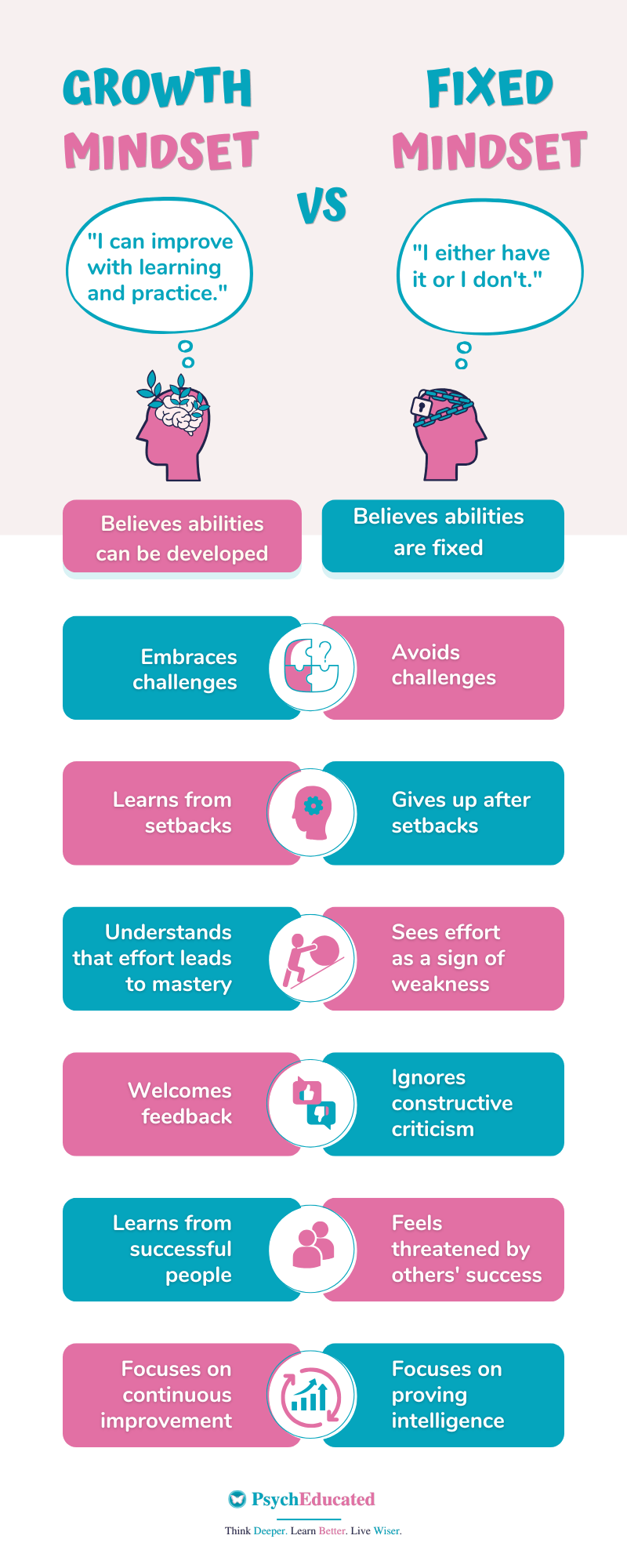
A fixed mindset views abilities as permanent traits. People with this mindset often avoid challenges, fear making mistakes, and see failure as proof that they lack ability.
A growth mindset views abilities as qualities that can be developed over time. Challenges become opportunities to learn, mistakes become valuable feedback, and success is seen as the result of continuous learning rather than innate talent alone.
The differences become even clearer when we compare how each mindset responds to everyday situations.
| Situation | Fixed Mindset | Growth Mindset |
|---|---|---|
| Facing a challenge | Avoids it whenever possible | Embraces it as an opportunity to learn |
| Making mistakes | Sees mistakes as failure | Sees mistakes as valuable feedback |
| Receiving criticism | Takes it personally or ignores it | Reflects on it and looks for ways to improve |
| Seeing others succeed | Feels threatened or discouraged | Feels inspired and learns from others |
| Encountering setbacks | Gives up easily | Adjusts strategies and keeps trying |
| Learning something new | Focuses on proving ability | Focuses on improving ability |
| Effort | Believes effort means a lack of talent | Understands that effort is part of mastering a skill |
It’s important to remember that mindset is not a personality trait. No one has a growth mindset all the time, and no one has a fixed mindset in every area of life.
For example, someone may confidently embrace challenges at work while believing they simply “aren’t creative” or “aren’t good at languages.” Our mindset often changes depending on the situation.
The encouraging news is that because mindset is based on our beliefs rather than our abilities, it can change. By becoming aware of the thoughts and assumptions that hold us back, we can gradually replace them with beliefs that encourage learning, resilience, and personal growth.
Why Is a Growth Mindset Important for Personal Development?
Personal development is often described as the process of becoming the best version of yourself. While that definition captures the essence of growth, meaningful personal development goes beyond achieving goals or acquiring new skills. It is a lifelong process of learning, adapting, and continuously improving the way we think, feel, and act.
At the heart of this process lies one fundamental belief: the belief that change is possible.
Without this belief, personal growth becomes difficult. If you are convinced that your intelligence, talents, or abilities are fixed, you are less likely to take on new challenges, persist when things become difficult, or learn from your mistakes. Over time, this can limit both your personal and professional development.
A growth mindset provides a different perspective. Instead of asking, “Am I good enough?”, it encourages you to ask, “How can I become better?” This subtle shift in thinking changes the way you approach challenges, setbacks, and opportunities for learning.
Research suggests that people who adopt a growth mindset are more likely to embrace challenges, persist in the face of difficulties, seek feedback, and use effective learning strategies. Rather than viewing effort as a sign of weakness, they recognize it as an essential part of developing expertise. While a growth mindset alone does not guarantee success, it creates the psychological foundation that supports continuous learning and improvement.
How a Growth Mindset Supports Personal Development
Developing a growth mindset can positively influence many areas of your life, including:
- Greater resilience. Setbacks become opportunities to learn rather than reasons to quit.
- Increased confidence. Confidence grows from repeated experiences of learning and overcoming challenges, not from never making mistakes.
- Improved learning. People with a growth mindset are more willing to experiment with new strategies and persist until they understand new concepts.
- Better emotional well-being. Viewing mistakes as part of the learning process can reduce the fear of failure and encourage healthier self-compassion.
- Stronger relationships. Believing that people can grow and change often leads to greater empathy, patience, and more constructive communication.
- Greater adaptability. In a rapidly changing world, the ability to learn, unlearn, and relearn has become one of the most valuable skills anyone can develop.
Perhaps the greatest benefit of a growth mindset is that it shifts your focus away from proving your worth and toward improving yourself. Personal development is no longer about being perfect. It becomes a journey of continuous learning, curiosity, and progress.
10 Science-Backed Strategies to Develop a Growth Mindset
Developing a growth mindset doesn’t happen overnight. It is a gradual process of changing the way you interpret challenges, mistakes, and success. Like any habit, it requires awareness and consistent practice.
The following strategies can help you cultivate a mindset that encourages continuous learning and personal growth.
1. Challenge Your Limiting Beliefs
Everything begins with the stories you tell yourself.
Many people carry limiting beliefs such as “I’m not smart enough,” “I’m too old to learn this,” or “I’ve never been good at public speaking.” Over time, these beliefs become accepted as facts, even though they are often based on past experiences rather than present reality.
A growth mindset begins by questioning these assumptions. Instead of asking whether you’re capable, ask whether you’ve given yourself enough time, practice, and effective strategies to improve.
Try this: The next time you catch yourself saying, “I can’t do this,” pause and ask yourself, “What evidence do I have that I can never improve?”
2. Embrace Challenges Instead of Avoiding Them
Growth happens just beyond your comfort zone.
People with a fixed mindset often avoid situations where they might fail because failure feels like a judgment of their abilities. In contrast, people with a growth mindset understand that challenges are opportunities to develop new skills.
Every challenge teaches you something, even if the outcome isn’t what you expected.
Try this: Choose one task you’ve been avoiding because it feels difficult, and commit to taking the first small step today.
3. Redefine Failure as Feedback
Failure is one of life’s greatest teachers, but only if you’re willing to learn from it.
Making mistakes doesn’t mean you’re incapable. It means you’re doing something that stretches your current abilities.
Instead of asking, “Why did I fail?” ask the following:
- What worked?
- What didn’t work?
- What can I do differently next time?
This simple shift transforms failure from an endpoint into part of the learning process.
4. Replace Self-Criticism with Self-Compassion
Many people believe that being hard on themselves will motivate them to improve.
Research suggests the opposite.
Harsh self-criticism often increases anxiety and discouragement, while self-compassion helps people recover from setbacks and remain motivated to keep learning.
Treat yourself with the same patience and encouragement you would offer a close friend.
Remember: Being kind to yourself doesn’t mean lowering your standards. It means supporting yourself while working toward them.
5. Pay Attention to Your Self-Talk
The words you repeatedly say to yourself shape the way you think.
Compare these two statements:
“I’m terrible at this.” VS “I’m still learning.”
One closes the door to improvement.
The other leaves it open.
Although changing your language may seem like a small adjustment, it gradually changes the way you interpret your abilities and your progress.
6. Focus on Progress Rather Than Perfection
Perfection is an impossible standard.
Progress, however, is measurable.
People with a growth mindset don’t expect to master a skill immediately. They celebrate small improvements because they understand that expertise develops over time.
Instead of comparing yourself to others, compare yourself to who you were last month or last year.
7. Seek Feedback with an Open Mind
Constructive feedback can sometimes feel uncomfortable, but it is one of the fastest ways to improve.
Rather than viewing feedback as criticism, see it as valuable information that helps you identify blind spots and discover new ways of growing.
Remember that feedback is about improving your performance, not defining your worth.
8. Learn from People Who Inspire You
Instead of feeling discouraged by someone else’s success, become curious.
Ask yourself:
- What habits helped them succeed?
- What can I learn from their journey?
- Which of their strategies could I apply in my own life?
Successful people are not reminders of what you lack; they are examples of what is possible.
9. Develop a Lifelong Love of Learning
A growth mindset thrives on curiosity.
Read books.
Take courses.
Ask questions.
Learn new skills.
Explore ideas that challenge your current way of thinking.
The more you learn, the more you discover how much there is still to learn, and that curiosity becomes one of the strongest drivers of personal growth.
10. Celebrate Effort, Learning, and Persistence
We often celebrate achievements while overlooking the process that made them possible.
A growth mindset values the effort invested, the lessons learned, and the persistence shown along the way.
Every time you choose to keep learning despite uncertainty or setbacks, you strengthen the mindset that supports long-term personal development.
Growth is rarely the result of one extraordinary moment. More often, it is the outcome of many small decisions to keep moving forward, one step at a time.
Common Obstacles to Developing a Growth Mindset
Developing a growth mindset is not about making a single decision to “think positively.” It involves changing deeply rooted beliefs about yourself, your abilities, and your potential for growth. Since these beliefs often develop over many years through personal experiences, education, and feedback from others, changing them takes time and consistent effort.
If you occasionally find yourself falling back into old patterns of thinking, don’t be discouraged. Growth is rarely linear. There will be moments of progress, setbacks, and self-doubt. What matters is not achieving a perfect growth mindset, but becoming more aware of the beliefs that influence your behavior and learning to respond to them differently.
Here are some of the most common obstacles people encounter along the way.
1. Fear of Failure
Many people avoid new challenges because they fear making mistakes or being judged by others. When failure is seen as a reflection of personal worth, it becomes something to avoid rather than an opportunity to learn.
How to overcome it: Instead of asking, “What if I fail?” ask yourself, “What might I learn from this experience?”
2. Negative Self-Talk
Our inner dialogue has a powerful influence on how we perceive ourselves. Thoughts such as “I’m not smart enough” or “I’ll never be good at this” can become self-fulfilling if left unchallenged.
How to overcome it: Notice your automatic thoughts and consciously replace them with more balanced and constructive ones. For example, change “I can’t do this” to “I can’t do this yet, but I can improve with practice.”
Read more: How To Block Negative Thoughts: 9 Easy Tips
3. Comparing Yourself to Others
In today’s world, it is easy to compare your progress with someone else’s achievements. However, these comparisons often ignore the time, effort, and experiences behind another person’s success.
How to overcome it: Compare yourself with your past self rather than with other people. Focus on your own progress, no matter how small it may seem.
4. Wanting Immediate Results
Personal growth takes time. Many people become discouraged because they expect rapid improvement and lose motivation when progress is slower than anticipated.
How to overcome it: Shift your attention from immediate outcomes to consistent daily improvement. Small actions, repeated over time, often lead to significant long-term change.
5. Surrounding Yourself with Limiting Beliefs
The people around us can influence the way we think about ourselves and our potential. Constant exposure to discouraging messages can reinforce a fixed mindset.
How to overcome it: Spend more time with people who encourage learning, curiosity, and personal growth. Read books, listen to podcasts, or follow educators and psychologists who inspire you to keep learning.
Remember that developing a growth mindset does not mean you will never experience fear, doubt, or disappointment. It means learning not to let those experiences define what you are capable of becoming. Every challenge you face is another opportunity to strengthen your ability to learn, adapt, and grow.
Frequently Asked Questions About Growth Mindset
Can anyone develop a growth mindset?
Yes. A growth mindset is not something you are born with; it is a set of beliefs about learning and personal development that can change over time. While some people may naturally be more open to challenges than others, everyone can learn to adopt a more growth-oriented way of thinking through self-awareness, practice, and experience.
How long does it take to develop a growth mindset?
There is no fixed timeline. Developing a growth mindset is an ongoing process rather than a one-time achievement. As with any habit, changing the way you think takes consistent practice. Some changes may happen within a few weeks, while deeper beliefs may take months or even years to reshape.
Can I have both a fixed mindset and a growth mindset?
Absolutely. In fact, most people do.
You might have a growth mindset when learning a new language but a fixed mindset when it comes to mathematics, public speaking, or creativity. Your mindset can vary across different areas of your life, and becoming aware of these differences is the first step toward change.
Does having a growth mindset guarantee success?
No. A growth mindset does not guarantee success, nor does it eliminate failure or setbacks.
What it does is increase your willingness to learn, persist through challenges, seek feedback, and improve over time. Success depends on many factors, including effective strategies, opportunities, support, and sustained effort.
Is a growth mindset the same as positive thinking?
No.
Positive thinking focuses on maintaining an optimistic outlook, whereas a growth mindset is based on the belief that abilities can be developed through learning, practice, and experience.
A person with a growth mindset does not ignore difficulties or pretend everything will work out. Instead, they acknowledge challenges while believing they have the capacity to improve.
What is the most important habit for developing a growth mindset?
One of the most powerful habits is learning to reflect on your experiences.
After facing a challenge or making a mistake, ask yourself:
- What did I learn?
- What worked well?
- What could I do differently next time?
Regular self-reflection helps transform everyday experiences into opportunities for learning and continuous improvement.
Why is a growth mindset important for children?
Children who develop a growth mindset are more likely to embrace challenges, persist when learning becomes difficult, and view mistakes as a natural part of the learning process. Parents, teachers, and caregivers can encourage this mindset by praising effort, effective strategies, perseverance, and progress rather than focusing solely on results or innate ability.
What books can help me learn more about growth mindset?
If you’d like to explore this topic in greater depth, here are some excellent resources:
- Mindset: The New Psychology of Success by Carol S. Dweck
- Grit by Angela Duckworth
- Atomic Habits by James Clear
- Peak by Anders Ericsson and Robert Pool
Each of these books offers valuable insights into learning, perseverance, expertise, and personal development from a slightly different perspective.
Conclusion
Personal development is often associated with achieving goals, learning new skills, or becoming more successful. While these outcomes are important, they all begin with something much deeper: the way we think about our own potential.
Developing a growth mindset doesn’t mean believing that success will come easily or that effort alone guarantees results. Instead, it means recognizing that your abilities are not set in stone. With curiosity, effective strategies, consistent practice, and a willingness to learn from both successes and setbacks, you can continue to grow throughout your life.
The journey toward personal growth is rarely a straight line. There will be moments of uncertainty, mistakes, and challenges along the way. However, each obstacle also offers an opportunity to learn something new about yourself and to develop the skills and resilience needed for future success.
Perhaps the most important lesson is this: you don’t have to become a different person to grow. You simply have to become a better version of who you are, one small step at a time.
As you move forward, try to focus less on proving your abilities and more on developing them. Replace the fear of failure with curiosity, welcome challenges as opportunities to learn, and remember that meaningful growth is not measured by perfection but by continuous progress.
Every expert was once a beginner. Every skill you admire was once unfamiliar. The person you hope to become is shaped not by where you start, but by your willingness to keep learning.
Your growth mindset begins with the next challenge you choose to embrace.
References
- Dweck, C. S. (2006). Mindset: The New Psychology of Success. Random House.
- Dweck, C. S. (2017). Mindset: Changing the Way You Think to Fulfil Your Potential. Robinson.
- Burnette, J. L., O’Boyle, E. H., VanEpps, E. M., Pollack, J. M., & Finkel, E. J. (2013). Mind-sets matter: A meta-analytic review of implicit theories and self-regulation. Psychological Bulletin, 139(3), 655-701.
- Yeager, D. S., & Dweck, C. S. (2012). Mindsets that promote resilience: When students believe that personal characteristics can be developed. Educational Psychologist, 47(4), 302-314.
Further Reading